Wednesday, 1 October 2014

Call from DEFRA

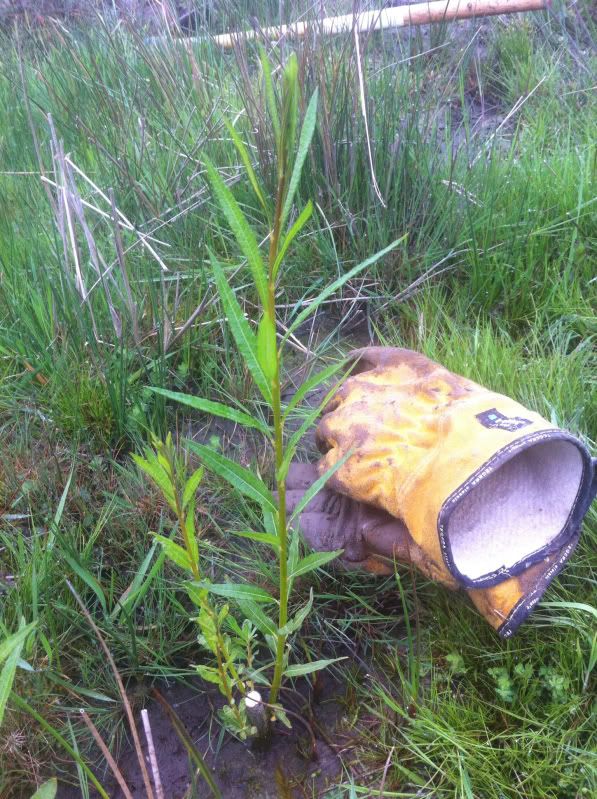
Received a call from DEFRA this morning asking whether I'd planted any sweet chestnut seedlings for nut production as they are monitoring them for blight. As mentioned before, I haven't planted any as they were out of stock but I have at least one that has self seeded:


Sweet chestnut seedling

One of my two mature chestnut trees is producing nuts, but not many:
 
First nut!
 
I've potted some local chestnuts from a nearby wood so hopefully they'll come up in due course


Friday, 19 September 2014

The Grand Tree Survey

It's been a while since my last post, sorry about that!
As part of my agreement with the Woodland Trust, I have to replace lost trees (subject to an acceptable 20% loss) so thought it best to have a record of how my trees are doing.
I'd previously marked a few tubes with red flag, made from wire and tape, but the numbers didn't last and it wasn't a very organised approach.
Whilst looking for numbered tags, I found a company online that produces personalised cable ties so I ordered 200, hoping that I wouldn't need that many. They also had an option for a company name, which I took:


I constructed some survey tables and printed them off. In the space of a few days I'd looked down every tube and counted every spiral. It was a bit difficult identifying some of the trees now the leaves have fallen (and working out what the dead ones should have been was especially hard) but I finally finished surveying the lot (over 1500) and am proud to announce that only 65 didn't make it, a loss rate of about 4%. I'm planning on "beating up" those that need replacing, with sweet chestnut and wild pear. The latter liking heavy soil and the former being unfussy about soil types.

I'll publish the full data list in due course.


Sunday, 20 July 2014

What's wrong with these leaves?

In addition to the whips in my woodland, we've also begun to establish an orchard closer to the house, using larger trees. We've already planted an apple, medlar, cobnut and damson, plus a few currant bushes. Whilst wondering past today, I noticed the apple had suffered a bit of damage and on closer inspection noticed this little fellow:

Can you see it?


Apparently it's a type of hawk moth (privet hawk moth, I think) caterpillar. An amazing camouflage and hope the tree will survive so we can have some fruit in years to come!

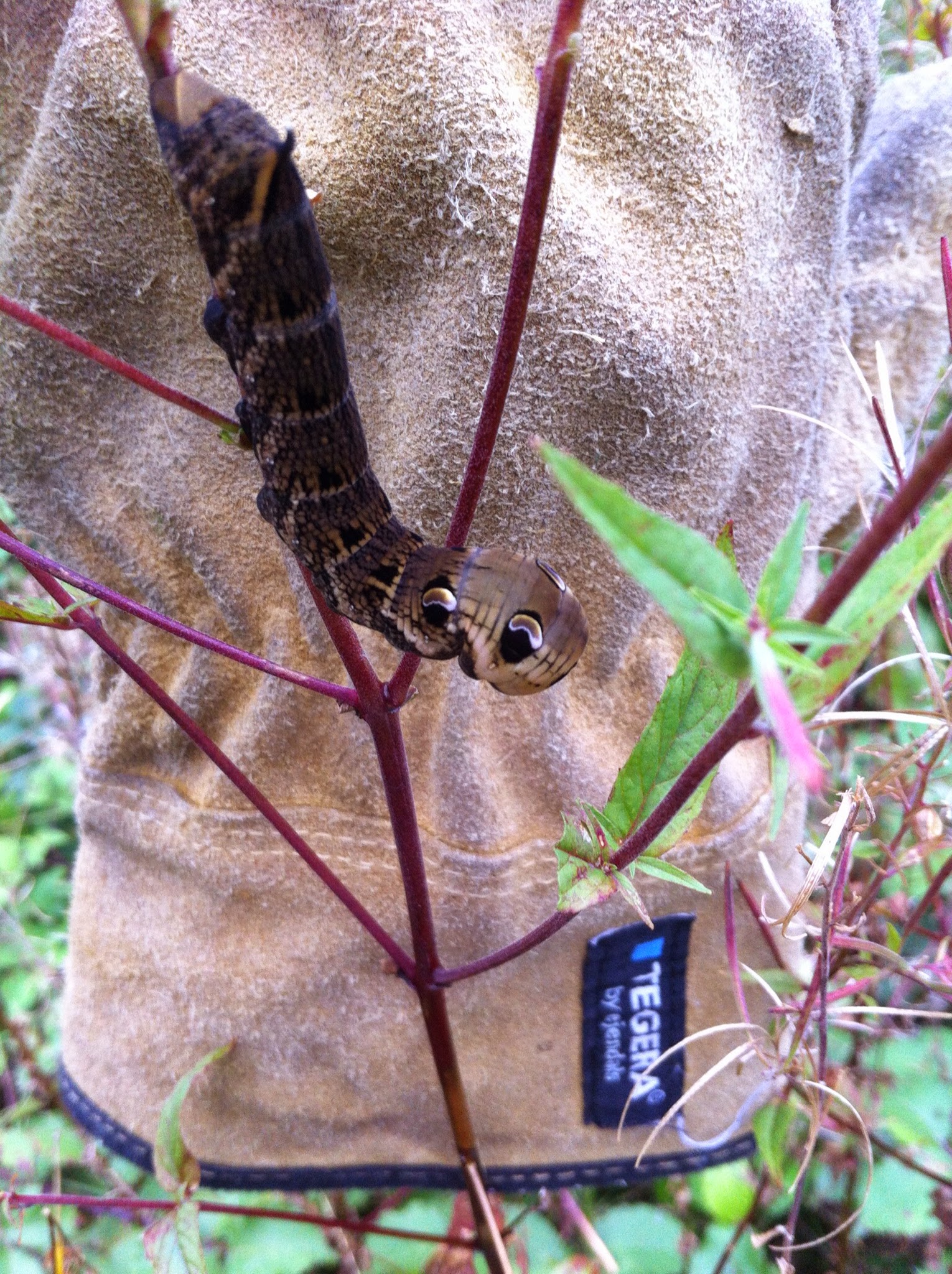
Further up in a willowherb weed, I spotted a scary looking character:

This is a different type of hawk moth, displaying in "snake mode" - they also have other modes of defence but nearly had me fooled

 
That said, not quite as convincing as this grass snake, which might have been playing dead but might have possibly have been damaged by one of the dogs. They grow to 6 feet in the UK but this was about 4 feet long. I've seen several around basking in the warmer weather and although I hope this one survived, they're not endangered


Monday, 16 June 2014

Newts and nymphs

The little pond in our garden tends to dry up in hot weather and seeing all the rubber liner looks unsightly. We were also worried about dogs and children going into it so decided to get it filled in.


Fortunately, I had the pond I'd dug all ready so we moved the plants (a lily, an iris and something else) up there in wheelbarrows:


Water lily

I'd partially drained the pond so I could place the lily in the middle. The other plants were placed on the edges, where I'd not dug it out to full depth.

We then had to think about what to do with the wildlife in the old pond. We knew there were no fish but had been told there were newts in there. Some pond dipping with a small net brought up an impressive number of smooth newts, which were tipped into a bucket of water and taken up to the new pond. Included in the catch were a load of large dragonfly nymphs (some of them larger than the newts!):


Dragonfly nymph

The easiest way of finding them was to tip a bucket of pond water onto a perforated tray. The newts and nymphs could clearly be seen wriggling and were placed into the holding bucket


Smooth newt

I estimate about 25 newts were moved. They're now in a much bigger pond, fed by a spring so if shouldn't dry up.


Wednesday, 21 May 2014

Willionaires

Willow gets me excited.

As a lazy man, planting and tending trees was a serious effort and the speed at which willow grows is amazing, which is why it’s planted for biomass in many parts of the World. To grow willow could hardly be simpler. For most species, you buy (or acquire) a stick, called a rod, about the size of a pencil. As the name suggests, you stick this in the ground and voila! A willow tree ensues. It’s so potent and ready to root that an infusion made from bits of willow wood soaked in water will stimulate many other plants to root, saving money on expensive hormone powders. It’s good for feeding livestock as well as having multitudinous other uses, such as weaving and forming living structures.

To give you an idea how rapidly it can grow, in my old house, there was a willow tree (I think it’s osier viminalis – common osier – but possibly hybridised with something as I’m sure the leaves were variegated) planted in the flowerbed next door. It provided too much shade for the occupants and I was asked if I could trim it in exchange for keeping the trimmings. Not the best deal in the World, you might say, and you would be right but I kept on top of it for a couple of years. One year, I was getting tired of individually sawing through the shoots that were too thick to cut with secateurs and knowing that it wasn’t a well loved shrub, I too my chainsaw and cut the thing down to a stump, about as flush to the ground as was possible. The sad stump sat there for the Winter. We has assumed that it was dead and weren’t particularly bothered. However, in the Spring, small green shoots started to appear and by the end of that year, they were up to 3m long and 30mm in diameter. IN. ONE. YEAR. I’ve taken many of these trimmings and planted them at our current property where they are doing very well, although as not coming from a well established stump, I don’t expect they’ll produce the same growth this year.


Osier viminalis

Some economics:
To buy a stick of willow on eBay, for example, costs around 50p. You can find it cheaper but you can pay a lot more.
Now. To encourage willow to produce straight shoots, it is desirable to plant them close together at, say, 50cm (0.5m) spacings. An acre is 4,047m2 which, if square, is roughly 63.5m along each side. Planting a stick at every half metre would give 128 plants along each side, a total of 16,384. If each of these plants put out 10 shoots (whips) of 2 metres each, and each shoot was cut into 25cm length that would mean 80 rods per plant. In one acre, that’s 1,310,720 rods, which at 50p each, is £655,360. Per acre. Per year. The willow I cut down produced many more shoots that this – I reckon I planted about 400 rods and had many longer whips left over which I stuck in the ground for want of something else to do with them. Now, I hear what you say, selling that amount in would not only be difficult but would also attract some sort of bulk discount. Let’s say you sold the lot at 10p each. That’s still £130,000. Obviously, you’d need some sort of harvesting and cutting equipment in addition to the handling/postage costs but you can see why I asked my father-in-law, after pointing out we owned 10 acres “What colour helicopter would you like?”*

* the difficulty being that we’d have nowhere to land them as all the land would be covered in willow

Regarding biomass, we are accustomed to burning logs in this country, either on an open fire or in a woodburning stove. With a quick growing species such as willow, you might get a reasonable sized log in about 4 years, which then should be dried for a year or so before burning. Why, then, should one not be able to produce meaningful heat from the smaller shoots that we could harvest every year? The solution lies in a device known as a rocket stove, but I have only found one commercially produced version – the Stick Stove, from Black Mountain Wood Fuels (see links). However, I don’t consider this to be a very attractive stove and it’s quite a lot of money, but you must admire the technology. I am working on a similar stove, designed to work inside an old oil-fired Rayburn that we were given. Hopefully I can be burning my own willow soon and heating my workshop (unless I can convince my wife to let me put it in the house).

Trailcam pays for itself

I've connected my trailcam up to a bigger battery so can leave it out for a long time

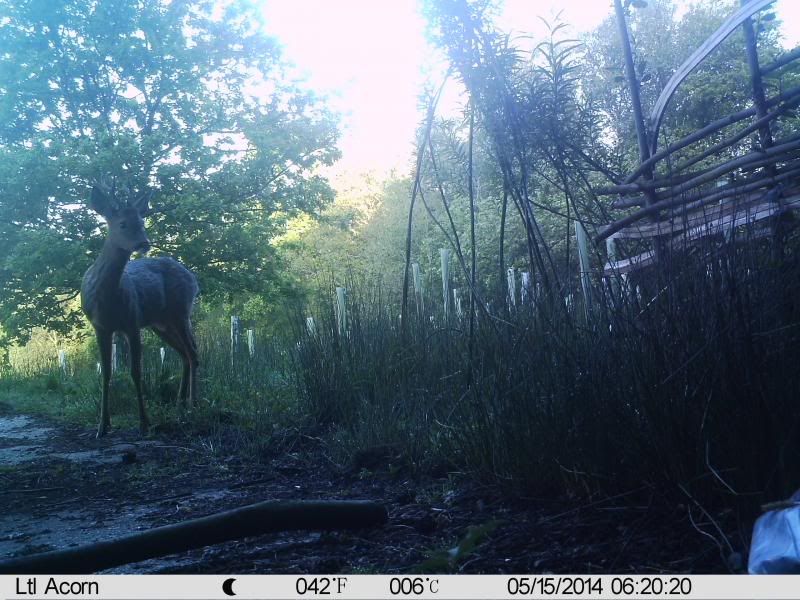
Had it out for about 10 days close to where something had been nibbling my willow and was rewarded with this fine chap. I thought deer would be most active at night but all the images/videos I've captured of him have been early in the morning:


Cheeky deer (roe deer)


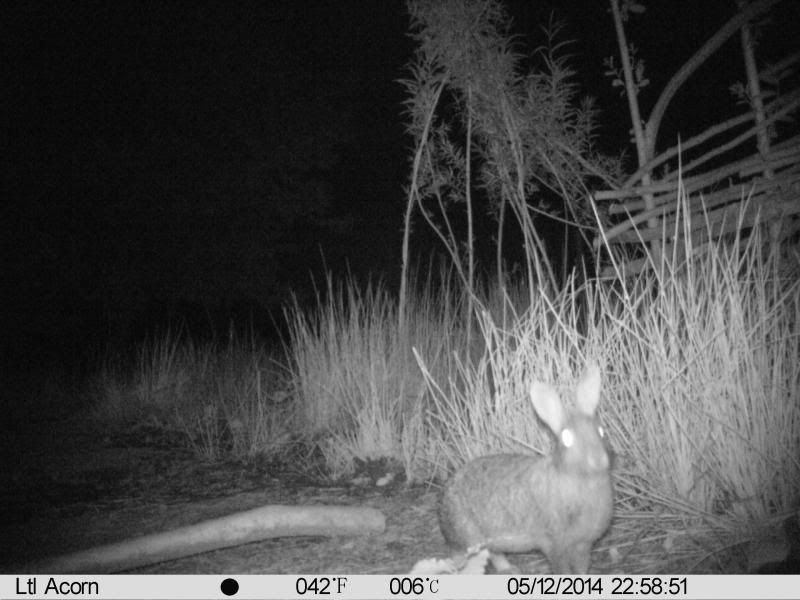
Also caught lots of other critters who are also in danger of being eaten:

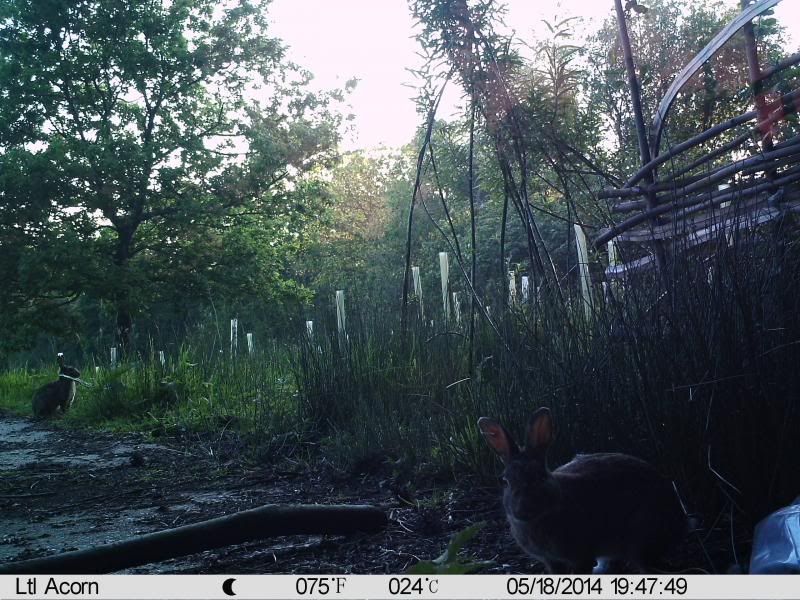
Crepescular rabbit

A marked man


Sometimes they don't come alone!

Future pair of slippers

 I notice that one has a torn ear - should make it easy to identify in future videos

Thursday, 8 May 2014

New springs & micro swales

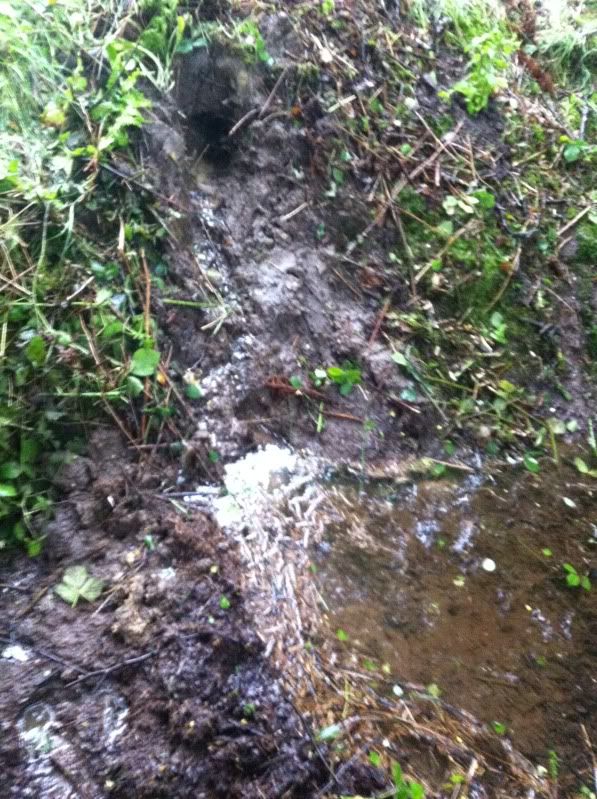
Found another very boggy patch today, right above one of the ditches. Closer investigation found a small spring right on the bank (I'm sure there are others) so I dug it out a bit to see if it would create some useful flow. Was pleased to note the presence of proper clay - it's the reason for the spring being there, of course but I'd not come across it before - the other spring is on green sand, which looks like white clay but doesn't form slip in the same way. I think it's still pretty impervious to water and if some leaks through the pond dam then the trees and plants downhill will benefit from it.

Just to the left of the outlet, you can see a ramson that I planted. It's one of many dotted around so we'll see if it thrives in such boggy ground.

New spring, dam and ramson


I then had the idea of using the spoil from this digging to form a small dam across the ditch in order to create a tiny pond. It struck me that although the ditch isn't dug on contour, it doesn't have much of a gradient and thus with a series of small dams, one could form micro-swales all the way down. This tiny pond soon filled up and considering my boots don't seem to be watertight, it wasn't especially comfortable working there. Added to the fact was the incessant rain and my waterproof trousers which keep coming down.

In order to access the ditch I had to clear a lot of brambles. I call this "therapy" as using a machete certainly takes some effort. Some of the old stems were 20mm thick - there's probably a use for them (blowpipe? flute?). 

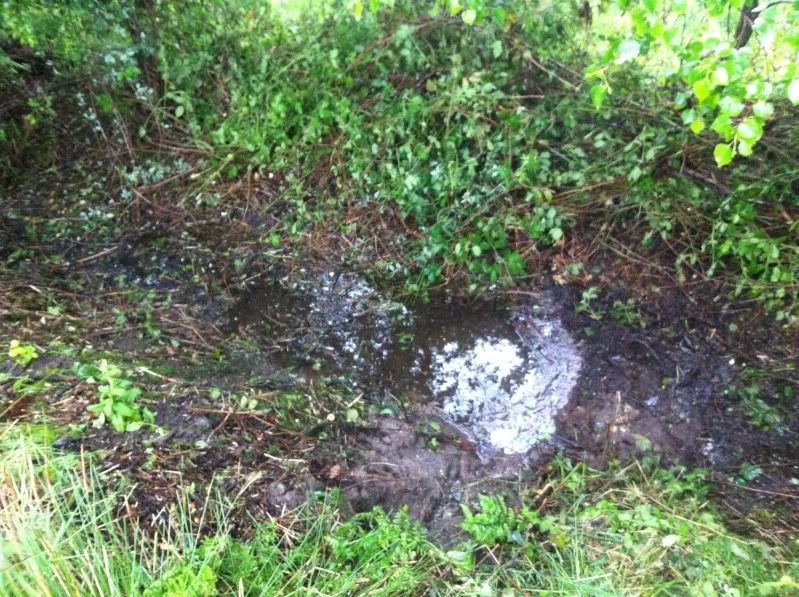
Fortunately, I started this task on an overcast, but dry, day and my heavy cotton smock (Titan) and leather gloves kept me scratch free. I piled the brash up as best I could to form a natural barrier and wildlife refuge. The field beyond is also ours so it doesn't have to be very secure but anything to stop the dogs from destroying the local fauna is a good thing in my book! You can see the dam and tiny pond in this picture with the brash pile on the far side. Plenty more brambles around for blackberry picking in the autumn and I imagine they'll soon shoot up through the brash pile anyway. I do need to get in there with a saw & open the ditch up a bit as lots of small trees have begun to invade. I can use the cut brush to reinforce my barrier and may get a bit of firewood from it too (it's mainly willow). Might be best to wait until Winter in case any birds are nesting there, I suppose.


Micro swale, brash barrier and mint


Now the bank was clear, I took the opportunity to plant some mint that we'd bought the other day from a garden centre. Planted black peppermint, ginger mint and apple mint. They'd doubled in size in the pots in under a week and this site should give them a decent home. It's quite shady but will get some direct sunlight and plenty of water. You may just be able to pick them out in the picture on the left hand side (the new spring is at the bottom of the image which is taken from the top of the bank)