Showing posts with label forest gardening. Show all posts

Thursday, 8 May 2014

New springs & micro swales

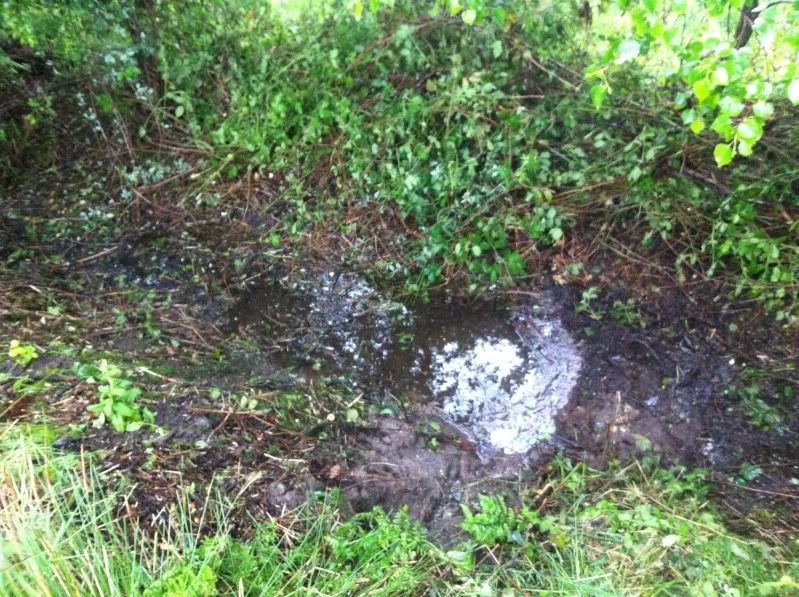
Found another very boggy patch today, right above one of the ditches. Closer investigation found a small spring right on the bank (I'm sure there are others) so I dug it out a bit to see if it would create some useful flow. Was pleased to note the presence of proper clay - it's the reason for the spring being there, of course but I'd not come across it before - the other spring is on green sand, which looks like white clay but doesn't form slip in the same way. I think it's still pretty impervious to water and if some leaks through the pond dam then the trees and plants downhill will benefit from it.

Just to the left of the outlet, you can see a ramson that I planted. It's one of many dotted around so we'll see if it thrives in such boggy ground.
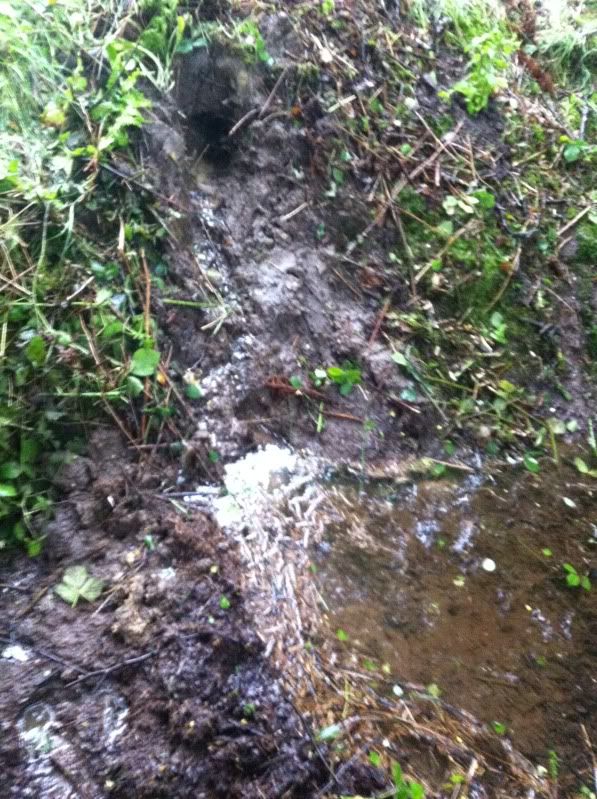
New spring, dam and ramson


I then had the idea of using the spoil from this digging to form a small dam across the ditch in order to create a tiny pond. It struck me that although the ditch isn't dug on contour, it doesn't have much of a gradient and thus with a series of small dams, one could form micro-swales all the way down. This tiny pond soon filled up and considering my boots don't seem to be watertight, it wasn't especially comfortable working there. Added to the fact was the incessant rain and my waterproof trousers which keep coming down.

In order to access the ditch I had to clear a lot of brambles. I call this "therapy" as using a machete certainly takes some effort. Some of the old stems were 20mm thick - there's probably a use for them (blowpipe? flute?). 

Fortunately, I started this task on an overcast, but dry, day and my heavy cotton smock (Titan) and leather gloves kept me scratch free. I piled the brash up as best I could to form a natural barrier and wildlife refuge. The field beyond is also ours so it doesn't have to be very secure but anything to stop the dogs from destroying the local fauna is a good thing in my book! You can see the dam and tiny pond in this picture with the brash pile on the far side. Plenty more brambles around for blackberry picking in the autumn and I imagine they'll soon shoot up through the brash pile anyway. I do need to get in there with a saw & open the ditch up a bit as lots of small trees have begun to invade. I can use the cut brush to reinforce my barrier and may get a bit of firewood from it too (it's mainly willow). Might be best to wait until Winter in case any birds are nesting there, I suppose.

Micro swale, brash barrier and mint


Now the bank was clear, I took the opportunity to plant some mint that we'd bought the other day from a garden centre. Planted black peppermint, ginger mint and apple mint. They'd doubled in size in the pots in under a week and this site should give them a decent home. It's quite shady but will get some direct sunlight and plenty of water. You may just be able to pick them out in the picture on the left hand side (the new spring is at the bottom of the image which is taken from the top of the bank)

Paddy field part one

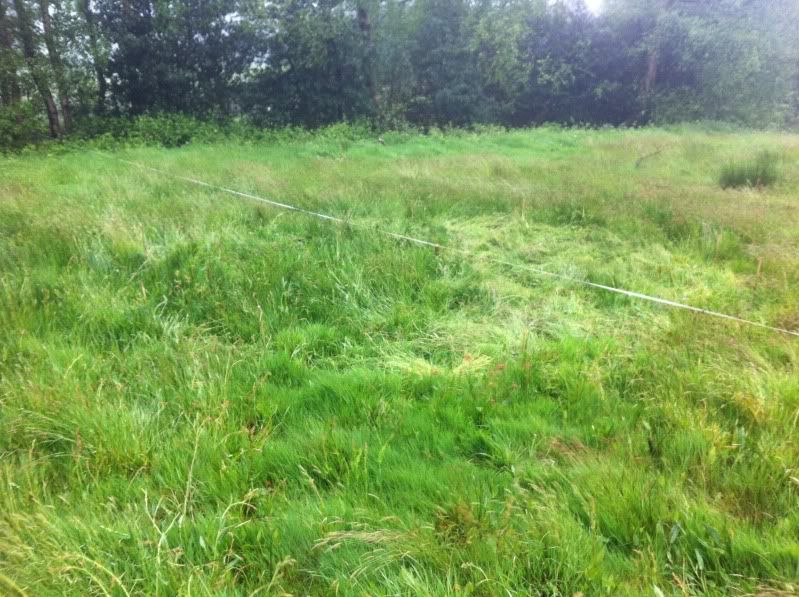
As can be seen in my posts about the pond (to come, sorry!), I'm planning on digging an overflow down to the ditch. This line is currently marked by some white tape that the previous owner had left lying around (it's electric horse tape). I recently had the idea from watching some permaculture video on YouTube to use this surplus water more effectively. A bit of research indicated that a Japanese rice variety, oryza sativa, can grow in the UK and establishing it in a paddy field would help to keep weeds to a minimum as few other species thrive in water (aquatic plants aside).

With that in mind, I hacked out a 5m circle with the machete to mark where to start digging. I'm hoping to get a mechanical digger in here but it's so wet that might not be possible. Going to be a big task to dig out by hand but I've done it before so I'm sure I can do it again!


The flow from the spring upstream of this should stop the water from getting too stagnant and the overflow from this will still flow into the ditch where I can pipe it into the lake as planned.

Tuesday, 6 May 2014

List of tree species at The Old Farm

Species Latin Name Approx number Notes
Ash Fraxinus excelsior 6 Only young saplings
Alder Alnus glutinosa 375 Introduced 2014
Apple Malus domestica 4
Aspen Populus tremens 50 Introduced 2014
Balsam poplar (we think) Populus balsamifera 2
Bay Laurus nobilis 3
Beech Fagus sylvatica 126 most introduced 2014
Birch Betula pendula 50
Blackthorn Prunus spinosa 50 Introduced 2014
Cobnut Corylus avellana 1 Introduced 2014 (if you count it as a different species to hazel)
Common osier Osier viminalis 100 Introduced 2014
Copper beech (2014) Fagus sylvatica 1 Introduced 2014
Crab apple Malus sylvestris 51
Damson (2014) Prunus institia 1 Introduced 2014
Elder Sambucus nigra 15
Eucalyptus Eucalyptus gunnii 1
Field maple Acer campestre 100 Introduced 2014
Willow, goat Salix caprea 3
Gorse Ulex europaeus 50
Willow, grey Salix cinerea 30
Hawthorn Crataegus monogyna 300 200 introduced 2014
Hazel Corylus avellana 201 200 introduced 2014
Holly Ilex aquifolium 30
Hornbeam Carpinus betulus 76 Introduced 2014
Leylandii Cupressus × leylandii 10
Medlar Mespilus germanica 1
Oak (Pedunculate) Quercus robur 150 Possibly some sessile
Pear Pyrus communis 3 Not sure of exact species
Plum Prunus domestica 2
Privet Ligustrum vulgare 1
Rhododendron Rhododendron ponticum 3 Behaving at the moment
Rowan Sorbus aucuparia 5
Scots pine Pinus sylvestris 26
Spindle Euonymus europaeus 50 Introduced 2014
Sweet chestnut Castanea sativa 1 more planned for 2015
Sycamore Acer pseudoplatanus 2
Wild cherry Prunus avium 125 Introduced 2014
Yew Taxus baccata 3 One of which is c. 400 years old
That's 38 different species (if you count hazel as two), well over 2,000 trees (if you count them all as trees - they're all taller than I am). There are some further ornamental trees that I've yet to identify and I seem to discover new trees every day tucked inside the hedgerows. Can't wait for most of them to grow bigger!

Monday, 5 May 2014

Ramsons & bees

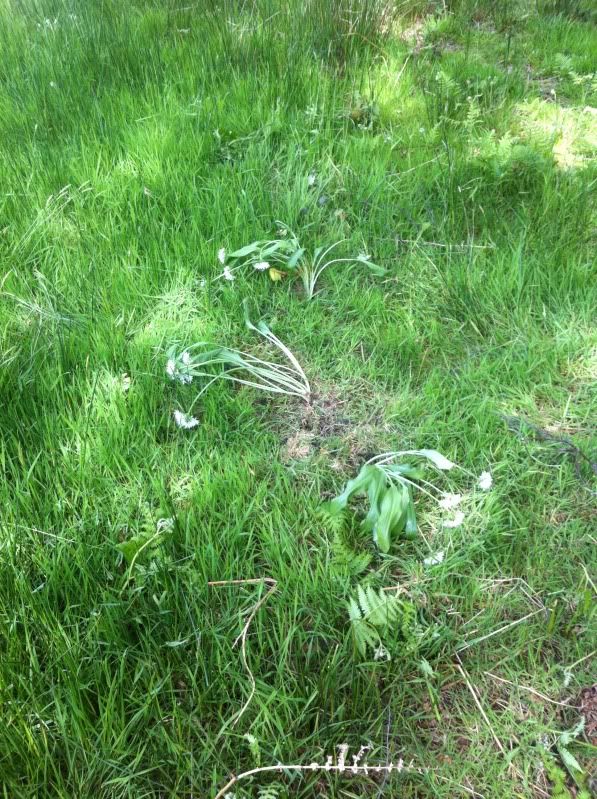
Whilst at Michelham Priory yesterday (4th May, 2014), I noticed a huge amount of wild garlic, allium ursinum, known as ramsons, flowering around the watermill. Every part of these is edible, but it's the leaves that are easiest to use. Was given permission to dig some up so came home with a good few large clumps. These are easy to separate into individual bulbs and I took the opportunity to plant them in various locations around the property to see where it will thrive. If it doesn't survive, we drove past a huge population along the Sussex country lanes on the way home so there's plenty to harvest, even if it means travelling a little way.

Planted some in sunny spots...

Allium ursinum

and some in shadier places...

Allium ursinum


I've also put some on the ditch banks (see "Springs and Micro-Swales") , others in pretty waterlogged soil & others in dry, sandy soil


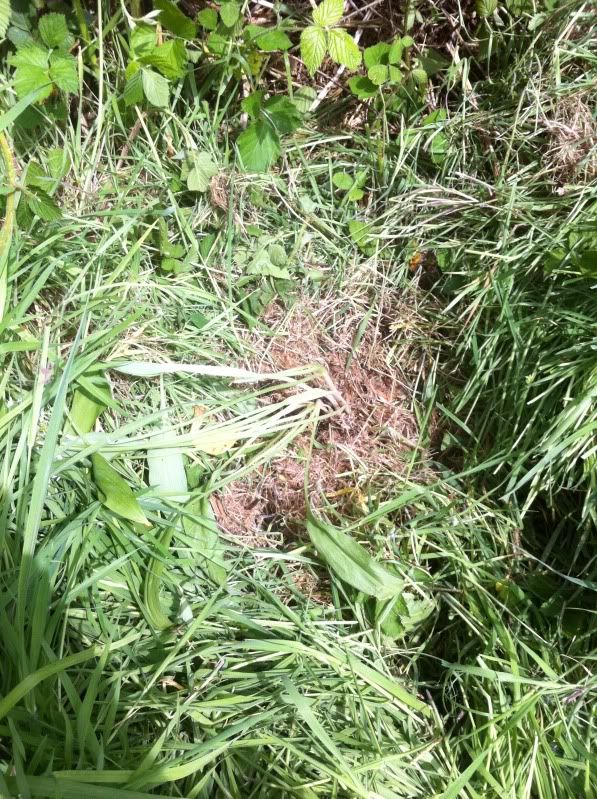
I planted one particular batch next to a small goat willow seedling I was given. Whilst clearing the grass away from the chosen site, I heard what sounded like escaping gas. Thinking I had just dislodged a pocket left over from the tree planting, I ignored it and carried on, but the noise grew louder and I soon realised I had stumbled across a nest of bees underground. As far as I can tell, they are a species of bumblebee but wasn't able to get a decent picture on my 'phone.

Friday, 2 May 2014

Willow deer damage

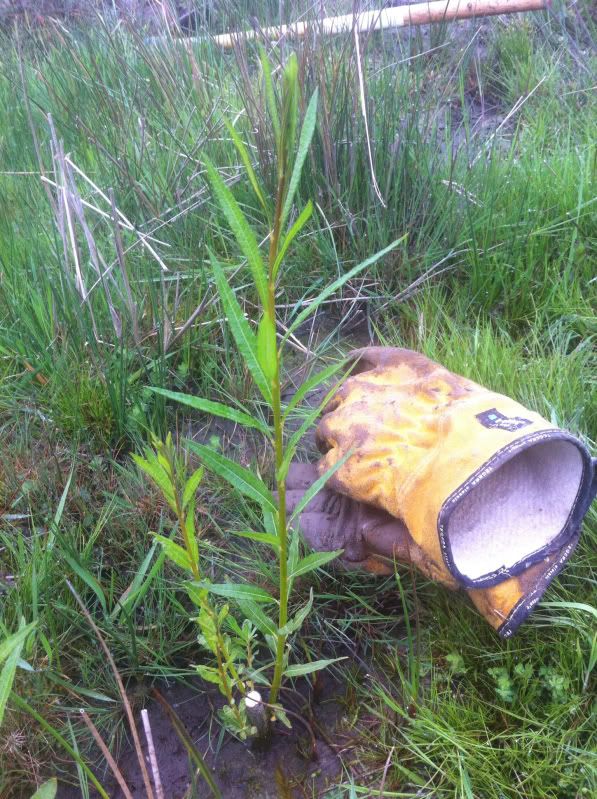
Here is some common osier willow, osier viminalis, that I think has been damaged by a deer. Need to set up the wildlife camera in case they strike again!

Common osier willow deer damage

These were shoots I had pruned from our next door neighbour in our old house. She had asked me to trim the shrub as it was blocking out quite a bit of light. I eventually got bored with cutting each individual stem and cut the entire thing to the ground with a chainsaw. Within a year, the new shoots were up to 3m long and 3cm thick - remarkable stuff and good for weaving/structural work. I've stuck a load of 25cm cuttings into the ground and most of them have taken, the tallest being about 60cm high. The gloves in the picture are Tegera 17 cut resistant gloves, available from Cromwells, they're the best all round gloves I've found so far.

Osier viminalis


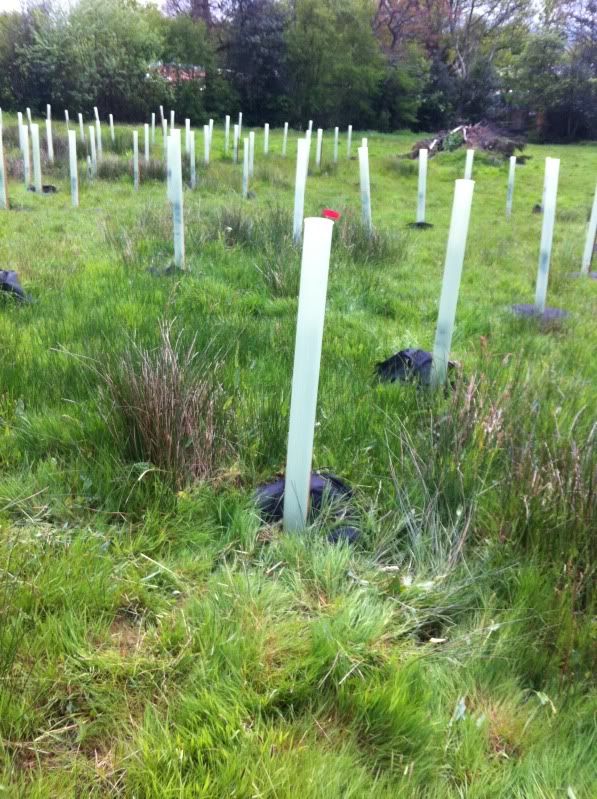
We also planted some in an organised plantation in spirals and they seem to be doing very well indeed. As from today, 4 plants (out of 64) had grown taller than the 60cm spirals. We've also planted some yellow willow but it's not doing so well as yet.

Osier viminalis


It's so easy to propagate that I'm not worried about the damage - I'd only stuck the damaged shoots into the ground as had got tired of planting the individual sticks but didn't have enough to build anything meaningful with


Emergency mulching

I had become to suspect that some of my trees had died. After some discussion on various forums, I decided to have a closer look at the victims.

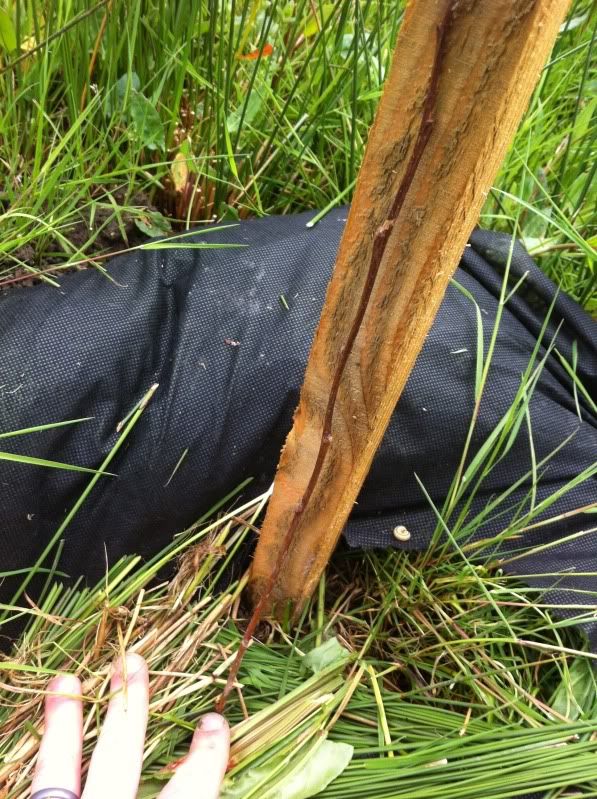
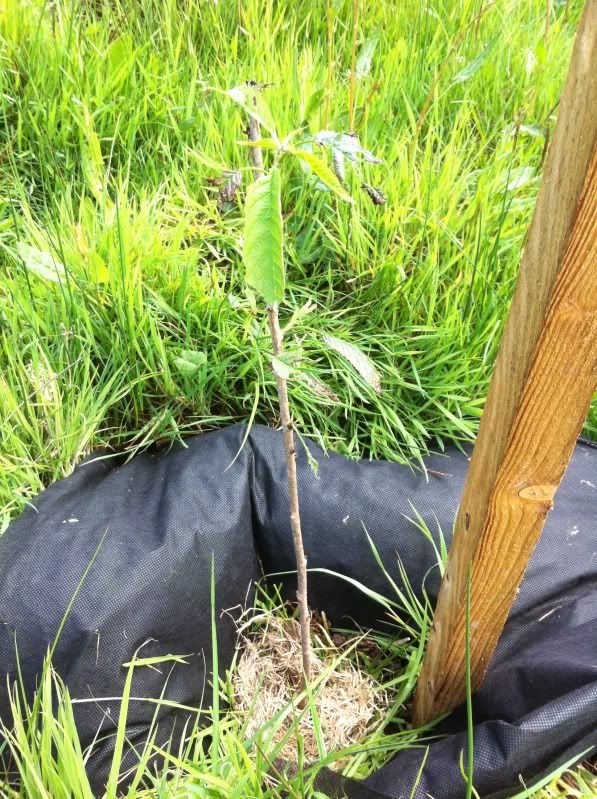
Whilst looking down the tube showed no growth, taking the tube off revealed a small amount of growth from the base of the tree (all alder, so far):

A barely living alder


To try and remedy this, I ripped out all the grass and weeds that were growing around the stem and shading it out. I then laid these down around the stem, making sure to keep the new growth uncovered. The tube is then replaced to hold the mulch in place and marked with a flag so I can keep tabs on it.

Can you see the flag?


Unfortunately, some of the trees that had been showing great growth have been attacked by some beastie and are now looking a bit sorry for themselves. This wild cherry, for example:


Wednesday, 23 April 2014

Willow Progress


The willows I pollarded in the Winter are covered in newgrowth and the dead hedge is anything but...


Pollarded willow


...


Dead hedge


The willow plantation is beginning to show some decent progress too (it seems that the yellow willow sticks we planted didn't make it* but the osier is doing well and should make for some decent weaving/structural material)


Willow plantation

* actually, they were a bit slow on the uptake but grew quite well in the end

Wednesday, 16 April 2014

The Epiphany

Despite wanting a woodland, for fuel and somewhere to wander about in, I hadn't given the subject much thought after that.

It was during a bored moment that I was surfing YouTube and stumbled across a video that changed my life:


I don't normally watch videos that are that long but this one scared me. Scared and inspired. For the next few days, all I did was watch video after video and read countless pages of information. I've been introduced to the work of Martin Crawford and Geoff Lawton, amongst others.

For those of you who don't want to watch the video, I can try to précis. The presenter, Rebecca Hosking, is trying to see how her family's farm can survive well into the future, a future where the oil is running out. She points out that the UK is a net importer of food and that supermarkets hold on average 3 days worth. Add panic buying into the equation and that makes for some rapidly hungry people.

As the title of this blog suggests, I'm no hippie. I have a job, run several cars and heat my house (partly) with fossil fuel. I shop in supermarkets and buy a lot of stuff from China and elsewhere. I eat meat, processed foods and imported coffee. I wash fairly often (through laziness rather than design) but have my hair cut, by Donna.

It struck me that when I hear of people using the term "organic", it conjures up images of patchouli scented, pot smoking hippies who say "man" a lot whenever they're not hugging trees. Why should someone who doesn't wish to spread chemicals on the ground be labelled like this? By the way, if you've never hugged a tree, I can recommend it - it was a surprise to me how wonderful it feels, you can really sense the permanence of this huge, living thing. To love nature isn't a bad thing. 

I realised that what I really wanted in life was a forest garden. I'm very fortunate to have the land available and hopefully the time too. Being a prepper is all very well, but how much food can one realistically stockpile? To survive long term, we need to grow more food locally. England is well placed to take advantage of this. We have plenty of water, as most of us experienced this Winter, the Winters are generally quite mild - no snow this time around, in the South East - and the Summers aren't too hot. 

As Martin Crawford and others have pointed out, any piece of land in this climate is trying to revert back to forest. It's only by putting in large amounts of effort (using oil based machinery & fertilisers) that we can stop this process. By taking advantage of this inclination towards lush woodland, we can live more in harmony with the natural world, whilst still taking advantage of what it can provide.


Tuesday, 18 February 2014

The trees arrive

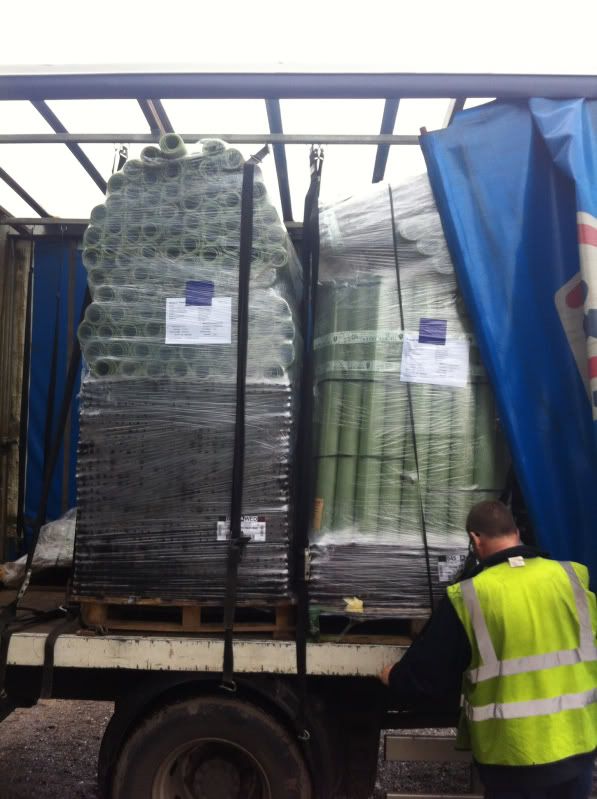
After what seemed like an age, the trees were delivered. Was a bit daunting to see how many tubes and stakes the order comprised! Thank goodness I didn't order 4,500 as suggested

The plants themselves didn't look too bad, how wrong I was:


Thought I'd better get cracking before my help arrived the following morning so planted 50 wild cherry trees. The first ones will form an avenue down the drive which should make for a beautiful arrival when in blossom.

First one!


I then continued planting the avenue


Once this was done, I moved into the upper paddock, where the real planting was going to take place. My wife suggested an avenue leading up to the pond would look nice, so that's what happened:


You can see how wet it is