Tuesday, 9 April 2019

Gone, but not forgotten

Last year we had to have our dog, Jarvis, put to sleep. We'd had him from a puppy and although he was only 10 1/2 when he died, like a typical cocker spaniel, he lived life at 100mph and his passing left a hole in our lives that will take a long time to heal. We scattered his ashes in the woodland and pond.

Clean bedding
For the last few years, since we lived here, he'd got into the habit of raiding the log store and most days I'd see him trotting off into the distance with a log in his mouth. I've still no idea why he did this as he never seemed to chew them, just carried them away for me to find with the mower later on (easiest way to find something lost in the grass is to first spend a long time sharpening and balancing a mower blade). I still come across logs dropped in the woodland which must provide some habitat for invertebrates but today I stumbled across this:

The Jarvis Tree
This is a willow (grey, I think) tree that has sprouted from a log dropped onto the damp ground. It's fallen over but otherwise looks pretty healthy. It's nice to know that he's left a reminder and maybe this was his plan all along? 

Monday, 1 April 2019

Spring Is Sprung and welcome ducks


Spring has finally arrived and the woodland is beginning to come back into life again. Thanks to The Woodland Trust, I planted another 100 trees (holly, Scots pine, hornbeam and small-leaved lime) which are all budding or showing little leaves already. The evergreens should give some colour and structure in the long winter months.

I also divided some bamboo that was dug up from near the house. I know there are concerns about it taking over but it provides excellent cover all year round and makes a lovely noise in the wind, as well as providing canes to help support spirals for future trees. I've lost bits in the past so it's not as hardy as people make out but there are new shoots appearing and it should be quick growing once the soil warms up fully.

Bamboo survived

The rest of the woodland is showing signs of life and aside from everything leaning away from the prevailing wind, very few were lost over the winter

The blossom avenue coming on strong


The blackthorn has also come into flower. Only 2 of them seem to have survived, out of the 50 that were planted. They've amalgamated into a dense hedge that is predominantly hawthorn but it's made that part of the boundary impregnable, at least by the dog!

Sloe gin anyone?


The willow fedge mentioned in the last post is also greening up and should provide valuable cover as well as soil reinforcement on the island.

Fedge

A group of ducks has started landing on the pond so I've woven a basic nesting tube in the hope that they'll stay. Might need lining with hay but the height should keep it safe from certain predators. It's woven from green willow, which wasn't quite as flexible as I'd have hoped and when it dries out it might become a bit loose but for a first try I'm quite proud of it. Had large clumps of frogspawn laid and some of them definitely hatched. No tiny frogs seen so maybe the ducks and the heron have eaten them all. Let's hope some of them survived but it's great to see life appearing in the pond

Nesting tube
Gelatinous


Also discovered some deer slots (tracks) by the pond. Not sure of species, but I see roe on the trail cameras quite often. The young trees are all in deer tubes, which should protect them from browsing, although I've lost a few shrubs when they get flayed by the bucks rubbing their antlers against them to remove the velvet.


Fallow or roe?


Sunday, 27 January 2019

Willow fedge on the island

It's January 2019 and the pond has been full since mid-December. The banks at the far end have collapsed (as designed) and have a variety of different levels and potential for habitat.

Full pond
When the sun shines it's beautifully tranquil and once the wildlife becomes better established I'm hoping it will look amazing.

    
Serenity
Now that there is a definite island, it needs planting. With some of the coppiced willow (osier viminalis), I planted a few metres of living hedge. Hopefully even in the poor soil this will take root and make a good barrier as well as reinforcing the banks.


Monday, 6 February 2017

Bramble control dilemma

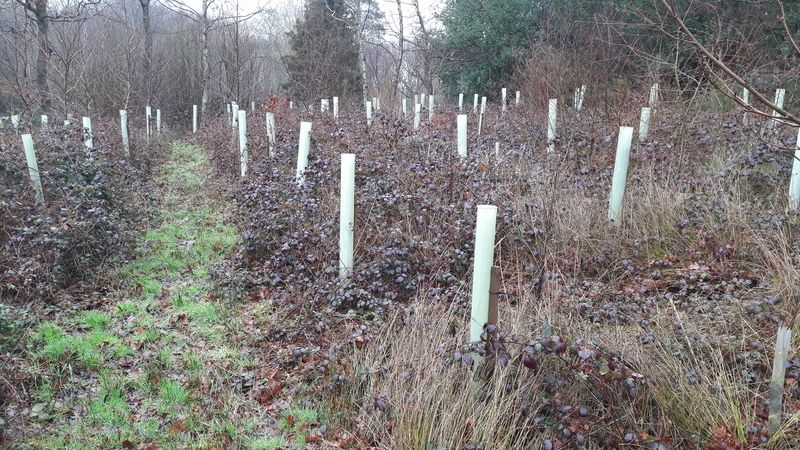
Some of my woodland was in danger of becoming impassable due to encroaching brambles.

 
Bramble, bramble everywhere


It's nice to see that the path I'd cut last year is still fairly clear but the plant tends to arch over and spread again so I decided to cut it.

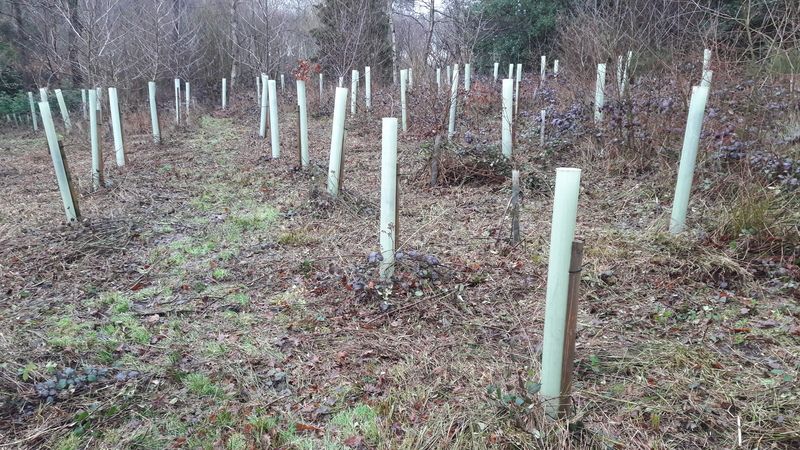
A few hours of work with the big mower left the scene looking a bit different:


Now there's still loads of brambles left and I've no doubt they'll sprout again where they've been cut but there are lot of naturally seeded trees that have sprouted up under this cover where the wildlife can't reach them due to the thorny protection. Now they're exposed I wonder if the deer will decimate the new growth and it has been pointed out that once the canopy is established, the brambles will be shaded out (although quite how big they'd be by the time the canopy becomes established is anyone's guess). I'm sure I've seen stands of bramble in coniferous woodland which is about as dense as it gets

The amazing willow

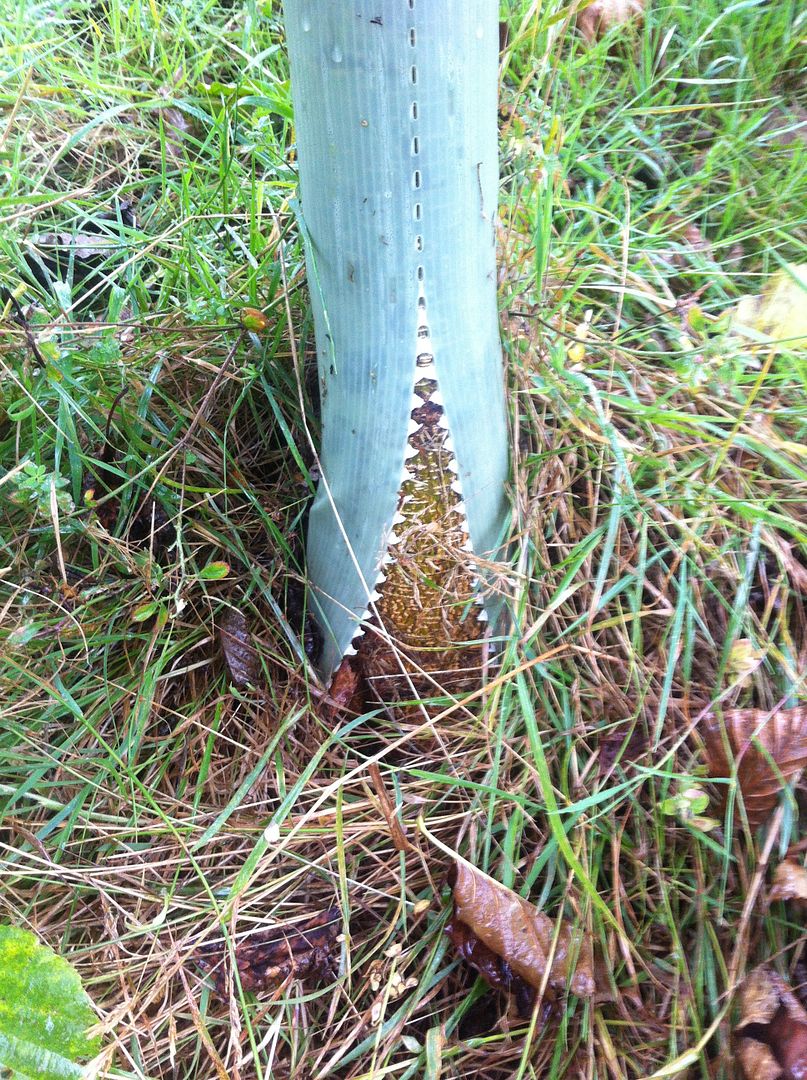
Haven't made a post for a while but plenty has been going on. Trees are still growing and some of the alder are beginning to split the tubes at the base. In a few weeks once the spring arrives (and there are signs of it today) I'll be removing some of the tubes.


Alder splitting tube
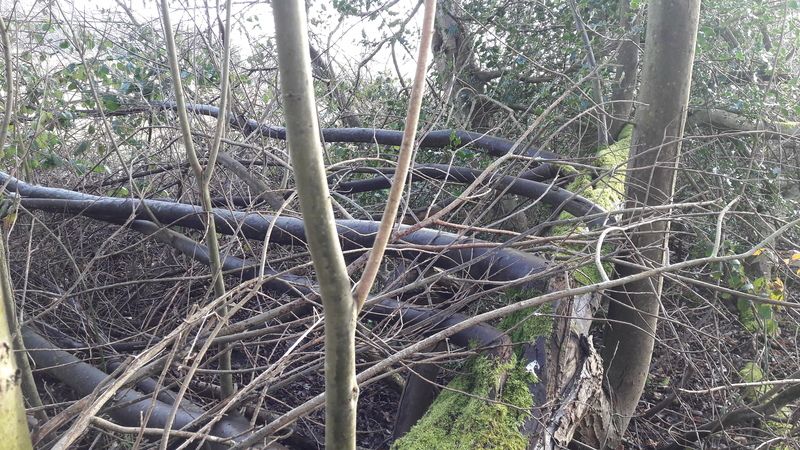
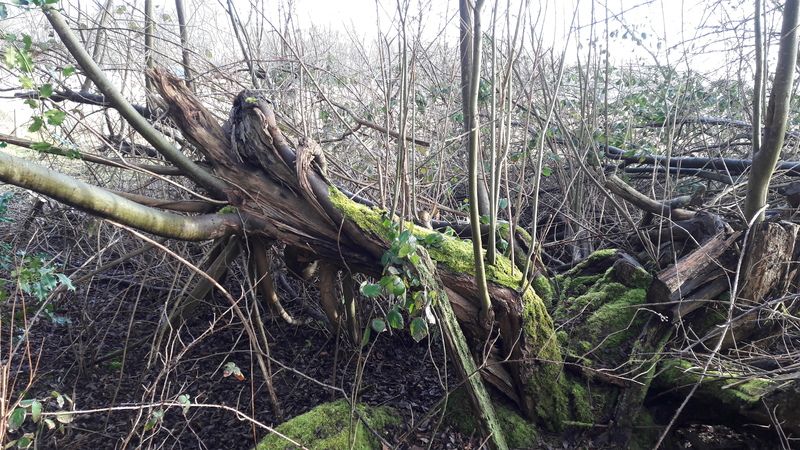
However, now that the leaves are off the trees it's easier to gain access to some of the more wild spots on the plot. One of these is where a large willow has fallen over and carried on growing:
Aren't trees supposed to grow up?


The trunk, or a large branch has obviously fallen over and begun to sprout upwards. These stems in turn blew over and are now growing horizontally. They curve up at the ends and create a dense, sprawling mass of vegetation that is great cover for wildlife
Pick a direction, any direction
It's twisted and contorted, growing down and along so that the original trunk/stump is barely recognisable. This is natural coppicing and many of the shoots have taken root where they've touched the ground. The whole tree must cover an area at least 15m squared and although I've cut a bit of it back for access, there's a considerable amount left

Wednesday, 13 April 2016

Drainage required...

Spent an exhausting few hours cutting my way along inside a holly hedge between the paddocks, in order to install stock fencing netting between them, as we have woodcock and ducks nesting which wouldn't take kindly to the dogs running around. To save time, I thought I'd run a load of fence posts and wire up in the Suzuki Jimny, which I bought as it's quite light and has chunky mud tyres.

However, it proved no match for the sodden ground and got stuck. It has a winch but the nearest stout tree was too far away. Eventually, I attached the winch cable to a small scrub willow, which was only about 3" in diameter. Surprisingly, it help well and I managed to pull the car out (sideways!) in just under 2 hours after dumping all the cargo in the middle of the field:

Bit muddy then...
The transient pond in the lower paddock, which will eventually be dug out into a much larger lake, has carved itself a decent little stream that overflows down beside the barn, making much of the ground down there waterlogged too. The plan is to get a proper drainage channel in to direct this into proper ditches as large portions of the land are currently impassable, even on foot (although I did manage to carry all the fence posts and wire up to where it's needed, in several trips)

The problem with drainage on this ground, I'm beginning to discover, is that with the very fine sand, even a decent size of drainage pipe will clog up quite quickly. For example, this pipe has been in the trench for under a year and is already buried in several inches:

Clogged drainage
Burying it in gravel might stave off the blockage for a bit but the old land drains I've discovered in my excavations are completely solid. The sand is so fine, it holds together almost like clay - doesn't let water through and sets solid. Where the inlet to the pond is (see earlier posts) a beach has formed. At first glance it looks like it would never hold any weight but it's quite firm underfoot

Tuesday, 29 March 2016

Spring 2016 - beautifying the willow

Can't believe it's been so long since I last posted but it's done little but rain...

Trees are just starting to come into leaf and we harvested the osier growth to build a twigloo:
Twigloo!
The osier was used to make the main structure and the yellow willow (which wasn't as tall) was planted around the bottom - it really glows in the sunshine and once it starts growing properly, we'll weave it into the twigloo which should eventually form a complete screen. There's also some violet willow planted on the entrance although the ground is so waterlogged, I'm not convinced it will survive... After some strong winds, I ventured out to find that most of the knots had failed and the whips were not joined at the top again. They're now tied with multiple whippings (using sisal) as well as being twisted around each other - shouldn't come apart again, especially one it begins to grow together.


This is one year's growth!


The osier is already sprouting and as you can see from the picture above, it's putting out multiple shoots and should continue to do so. The mulching at the bottom of the willow isn't really doing a great job any more, although now that the willow is established, I'm not sure it matters. 

The grey willow along the side of the barn needed sorting out as it was putting out shoots everywhere. The plan is to create a row of pollards so after a good deal of cutting, the larger trees looked like this:

Willow pollard
Some of the other trees had been cut a lot lower in the past and were resembling untidy shrubs, which made it very difficult to mow underneath. All the shoots except one were trimmed and regular bud pinching is carried out to prevent side growth. With any luck, these stems will thicken and next winter, they'll be trimmed higher up to stimulate growth from the top.

Single stem remaining

 Also bought a new billhook - this is an ex-military one and required a lot of filing/sharpening to make it fit for purpose. It's a bit heavy for the wife, though, so there's another one on the way! The handle on this one is cracked but currently solid. I've cut some holly down and there should be enough to make a handle for the new one as well as a replacement for this one too.


Cornelius Whitehouse 1940 billhook


Thursday, 25 February 2016

More mulching trials

The purpose of mulching is to suppress weeds and retain moisture until a tree is established. Commercial plastic matting is not only expensive, but it's often non-biodegradable. For individual trees, I like using cardboard. It's free, easy to handle and will rot down in a fairly short time. I know there are inks, glues etc. that are probably not ideal but it's a lesser evil than some of the alternatives. I recently completed my winter tree planting (up to 2,051 trees!) including some more dogwood on an unused corner. The previous planting here had been, shall we say, "disrupted" by an over enthusiastic use of a strimmer (not by me) which had cut through the spiral and stripped the bark without snapping the stem.


Strim that!


 The new trees were planted and a piece of cardboard was cut to fit over the stem and the supporting cane. These were weighed down with logs and then covered in woodchip. This should act as a decent mulch for some time, especially as the logs will take a long time to decay. 

Planting on a slope
 Some violet willow was also planted but on a sloping bank. This time, some synthetic membrane was used and it was found that the supplied pegs did not hold very firmly, especially in the wind. To counter this, some stout wooden stakes were roughly made with an axe and hammered in. These not only held the membrane down but also supported longer logs which really weigh it down. The logs also act as barriers to prevent the woodchip layer gravitating down the slope. We now have 6 species of willow growing:
  • goat willow
  • grey willow
  • common sallow (osier)
  • almond willow (black maul)
  • yellow willow
  • violet willow
The last 3 will be used for basketry and decoration once properly established. The almond willow isn't growing as vigorously as I'd have hoped but I'm told it often takes a year or two to really get going.

Saturday, 30 January 2016

A pair of ploughs for Christmas?

Christmas Day was not a Dickensian display of white snow but the standard grey drizzle that seldom seems to feature on any cards. My wife announced that she had bought me a present but it wouldn't be ready until the end of January. I asked her to keep it a surprise.

However, after I'd opened a book on smallholding and another on keeping pigs, I enquired if she'd bought me a pig. She replied that the seller wouldn't sell them individually and so a few weeks later, I collected a fine pair of Gloucester Old Spot/saddleback cross weaners from a nearby farm:

Scratcher and Hamlet (yes, I know you shouldn't name them)

Currently they're in an enclosure build onto the back of one of the stables. There is a partition inside and a door was cut in the back wall so they have somewhere to sleep. Due to the inclement weather, they haven't been pooing outside as we'd hoped, but the mixture of straw and dung should make good compost in a few months

I remember there being green...
The bottom of the enclosure has an electric tape (7000V!) running around it, to prevent them from digging under the wire. The pigs (both males, by the way) understood the significance of this tape in a very short order, although the dog was desperate to get at them. Funnily enough, it took her a lot longer to realise (after poking her paw through a few times) that pigs=pain but now she won't go within 20 yards of the pen. The other dog (not pictured) has been in to meet them and didn't seem particularly interested or fazed.

The plan is to move them into an electric enclosure that we've paid out in some scrub that will need to be cleared in order to survey and dig the lake. Once they've reduced this to bare mud, we'll move the enclosure to a different part:

Electric enclosure

However, despite them going frantic at the sight and sound of a feed bucket, they were so scared of the tape running across the gate into their enclosure, that we couldn't initially get them out (even though it was switched off as the energiser was moved to the temporary enclosure). Putting a piece of carpet over it solved that but then, despite being knee deep in mud for long periods of time, they wouldn't cross the muddy threshold into the paddock, let alone make the journey up to the enclosure (they hadn't been fed since the day before) and after a period of comedy pig chasing, we cut our losses and put them back where they were. The next plan is to buy an old horse trailer and let them feed in it. This will then somehow be manoeuvred into the field and reinstated as a mobile pig ark. However, with the state of the ground being so bad, it's not going to be easy...

Pigs are due to be slaughtered in June but we have some others on order already to replace them. It's going to be difficult as they're charming beasts but we must remember they were only born because people eat them (and with the amount they eat, they're expensive pets!). Hoping that once the willow really gets going we can supplement their diet with tree fodder but it may have to be a summer thing for the next pair...

Thursday, 12 March 2015

Introducing... MicroMulch!

As I was keen not to use chemicals when growing my trees, the only other option to control weeds was mulching. Unfortunately, the membrane used was a bit flimsy and although it might have been OK with woodchip on top, the amount needed and the difficulty in carrying to where it was needed, meant that most of the trees didn't get mulched as much as they should have been.

What's the purpose of mulch? Weed control and keeping moisture in the soil. The latter isn't a problem, in many places there is too much moisture and I'm worried the trees are going to drown, but the sheltered conditions inside the tree tubes is also ideal for many weeds, mainly grass but also docks, sorrels and rushes.

Lifting the tubes to remove the weeds is quite therapeutic, especially on a sunny day like today, but I got the feeling that I was only delaying the problem and that the weeds would soon grow up again. A parcel that arrived was wrapped in cardboard and it gave me an idea:

A few minutes work with scissors gave me a handful of postcard sized mulch mats that could be put around the trees in the bottom of the tubes. Easy to make and carry (again, to carry full sized pieces for mulching would not be practical and also sheet cardboard tends to make ideal habitat for voles, which have already destroyed a number of trees. Applying the mats is easy and gives a light proof barrier that should help suppress weeds for a few months, before the cardboard rots away. Hopefully in that time, the trees should be well enough established that they won't need further care

The tube is just pushed on top of the cardboard, holding it securely in place:

In about 30 minutes I'd mulched about 40, which is a lot quicker than conventional mulching would have taken. As predicted, the trees that had dropped enough leaves down inside the tube had made conditions too difficult for weeds (self mulching) - if only they were all like that.

I'm not sure how much affect weeds have when the trees are out of the tubes but it certainly looks neater when inspecting them - satisfying to see how thick some of the stems have grown - roll on spring!


Tuesday, 10 March 2015

Pesky wabbits!

One of the areas I've planted in is called "Fairy Grove" - it was initially planted by my wife and daughter as a circle of trees with a few surrounding it. As a surprise with some of the osier I'd cut back, I'd planted a little arch as an entrance way. In time we'll add to it so I'd put a few sticks in the ground nearby that should grow and could be woven in eventually. I made a template from cardboard which would be used to mulch them (we'd cover it in woodchip):

However, in these food scarce winter months, the rabbits are looking for things to eat and they stumbled across my willow. This was the result:


It's pretty tough stuff so it might survive but I quickly put spirals around the longer lengths which had also been attacked and they're already putting out catkins:


With the extra trees that I'd ordered the little Fairy Grove now has 62 planted in it - a veritable little forest!


A spot of coppicing

Along the side of the barn there is a row of willow trees. From what I can tell they are grey willow and frankly, they're not of a great deal of use. I'd coppiced a few of them last year and aside from some material to make dead hedges with and a small amount of thin firewood, it was a lot of work for little result.

They have grown back, though, not as vigorously as I might have expected but they put out about 8 feet of growth in a year. I was comparing them to osier, though, which is one of the fastest growers.

Anyway, the willows are underneath a power line and getting fairly close to it. Thought I'd neaten things up a bit so set to with the chainsaw and billhook:


The plan is to remove the new shoots from around the base of the trunks and end up with neatly pollarded trees. The regrowth from when they've been cut in the past is quite twisty and tangled in places plus it makes access down the side of the barn awkward when they come out low.

The poles were stacked up in my saw horse and cut to length. It's not big diameter stuff but burns really hot (when dry) and is good to get a fire going:

The saw horse (Oregon) makes it easy to cut lots of long bits to length at once:


With a bit of the leylandii thrown in for good measure that we had trimmed last week, it came to a reasonable volume and saves having to burn them on a bonfire:

Still not convinced it was worth the work but they needed doing and waste not want not!


See you next year!

The question remained of what to do with all the brash left over. It's very springy stuff and doesn't burn well when green as willow has one of the highest water contents but a few minutes with the saw horse and some sisal string made for some faggots. These can either be cut to length for burning in the log stove or used as the base of a future bonfire, maybe at the Summer solstice:


A friend of ours gave us an oil barrel that has been converted into a garden burner so we might burn the faggots in there to keep people warm for BBQs. Used a slip knot to secure the bundles so as they dry out I can tighten them up easily. I chose sisal as it's cheap and strong and safe to burn. Traditionally, they would have been tied with brambles and although we have plenty of those, I don't yet have a proper jig in which to make them with and bramble wouldn't take the strain. Some conservationists use them for reinforcing river banks but they take a long time to make (made 3 so far!) so not really a commercial proposition but I might make some enquiries if they fail to burn. There's still a large amount of brash left that needs dealing with - a tree surgeon would just chip it but I don't have a chipper and not worth hiring one in for such a relatively small amount.


Quite an industrious little setup!


Friday, 20 February 2015

Who needs flowers?

The yellow willow we'd salvaged from a weaving course last year was planted, alongside some osier, in a high density plantation to produce shoots for future weaving. It needs cutting back every year to encourage more shoots to grow so I trimmed it down. I was left with a bundle of about 20 sticks that weren't very straight and weren't of sufficient volume to be worth weaving with but rather that throw them away, I elected to put them in a vase as I thought they'd look "arty".

A few days later, they'd all sprouted leaves and a good network of roots. Once arranged in a slightly less haphazard style, they look beautiful and certainly last a lot longer than cut flowers:


The remaining stumps are getting ready to sprout again too but being colder outdoors (marginally!) they have some way to go:


Thursday, 5 February 2015

Beating Up

As part of my agreement with the Woodland Trust, I am allowed to lose 20% of the trees I planted and if any more die, I must replace them. The Grand Tree Survey calculated a loss rate of just over 4% (64 trees) and as I had wanted to plant sweet chestnut and wild pear from the beginning, I decided to order enough to replace them.

Looking around, there are many nurseries that supply common trees like that but some of them had minimum order numbers and before I knew it, I'd ordered 137 trees!:


50 x sweet chestnut (sativa castanea)

25 x wild pear (pyrus communis)

25 x black locust (robinia pseudoacacia) - this is the first non-native I've ordered. With climate change ever present, not all of our Northern European species are going to survive. Ash is under threat and many other species are struggling too (sweet chestnut, poplar, larch etc.) so some hardy foreign species were proposed. Robinia is a nitrogen fixer, so doesn't mind poor soils, it grows quickly, coppices well, has beautiful blossom and produces some of the best firewood there is. The wood is also very rot resistant. It is quite thorny, though, so these will be planted around the boundaries

25 x black maul/almond willow (salix triandra) - the best weaving willow. We have plenty of osier (viminalis) but that's more suitable for structural work - fedges etc. We'd like to try weaving some baskets or decorations so although paying for willow went against my better nature, into the basket it goes!

10 x dogwood (cornus sanguinea) - there is a roundabout in a nearby town that has been planted with dogwood and the stems are amazing. It's also useful for weaving and will add a splash of winter colour!

1 x black mulberry (morus nigra) - a belated anniversary present for my wife. The 5 year anniversary is wood and I had promised to buy her a fruit tree

1 x almond (prunus dulcis) - I love almonds and this one promises to be a good nut producer. Impulse buy! The roots on this had been quite severely pruned - I hope it survives:

--o--

The trees duly arrived and it was a pleasure planting such small numbers, without having to lug tubes and stakes around. I had a supply of spirals for such an eventuality for the extra trees and they all went into the database. Bit disappointed that the dogwood weren't particularly red, but maybe they take a year or so to get going. I think they produce edible fruits eventually and some of them will help shield some fencing.


16/02/2015 - I was away from home, satisfied that all my trees were in the ground ready for spring. My wife texted to say "your trees have arrived and need paying for". After a brief discussion we discovered that one of the nurseries I'd initally made enquiries about (who couldn't supply the chestnut) had located some and delivered:

50 x sweet chestnut

10 x wild pear

10 x black locust

1 x black mulberry

I immediately contacted the nursery and after reaching an amicable agreement, once I got home again, I planted the extra trees. Losing them wasn't too difficult and for such a small number, it didn't take too long.

Behind our stables there is a patch of wasteland. A large leylandii tree fell down and shattered the fence and there are a few elder and privet trees there, indicating it's not brilliant land. Decided to start rebuilding the boundary with some of the black locust, which has been planted inside a dead hedge:

There's some way to go before it's completely dog proof but hopefully the spiky robinia will make it a secure hedge, if it can outcompete the willow which will probably start growing too. Getting the material to the site isn't easy and the ground is so full of rubble, old bits of fence wire and other rubbish, actually getting it in the ground is proving problematic.


Either by mistake or design, some of the nurseries had supplied more than the order (by one) so I eventually ended up with:

104 x sweet chestnut

38 x wild pear

36 x black locust

25 x black maul

11 x dogwood

2 x mulberry

At time of writing, there are 1,681 trees in my database - just hope I'm around to see them all grow! I haven't included most of the willow sets I stuck in the ground in various places. There are also hundreds of naturally seeded trees, mainly oaks, willow and birch which are excluded. The mature trees aren't currently recorded either but there's a future project.